Mastering Precision: A Guide to the 3D Round Shape Roller, 6-8-10-12 Mm for Crafters and Makers
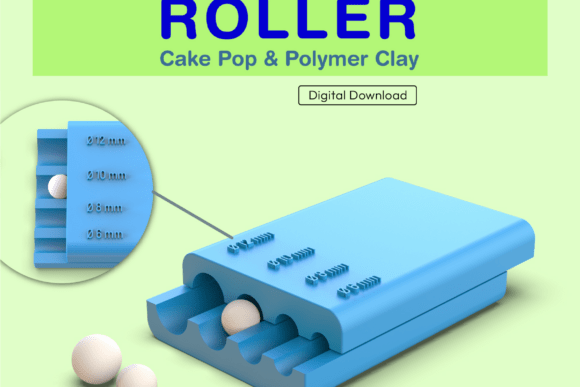
If you have ever spent hours smoothing out fondant only to find it uneven, or struggled to get consistent thickness in your polymer clay projects, you understand the frustration of manual inconsistency. This is where digital fabrication meets traditional craftsmanship. The 3D Round Shape Roller, 6-8-10-12 Mm is not just another gadget; it is a precision tool designed to eliminate guesswork from your creative process. By downloading this STL file and printing it on your home 3D printer, you gain immediate access to four distinct sizing options that cater to a wide variety of textures and structural needs.
This tool bridges the gap between hobbyist enthusiasm and professional-grade output. Whether you are a small business owner selling handmade ceramics, a baker decorating wedding cakes, or an educator teaching sculpting techniques, consistency is key to quality. Let’s explore how this simple yet effective digital download can transform your workflow and elevate your final products.
Why Consistency Matters in Creative Projects
In both baking and sculpting, uniformity is often the difference between a good result and a great one. When working with materials like clay, dough, or fondant, varying thicknesses can lead to uneven baking, cracking during firing, or structural weaknesses in your design. The 3D Round Shape Roller, 6-8-10-12 Mm addresses this by providing fixed-height guides. Unlike standard rolling pins that rely on your hand pressure and visual estimation, these rollers ensure that every millimeter of material is compressed to the exact same depth.
For professionals, this reliability translates to efficiency. You spend less time correcting mistakes and more time focusing on intricate details. For beginners, it builds confidence. Knowing that your base layer is perfectly flat allows you to experiment with complex patterns without worrying about the foundation collapsing.
Real-World Applications Across Different Crafts
The versatility of this tool lies in its multi-purpose design. Here is how different creators can integrate it into their daily routines:
- Baking and Confectionery: For cake decorators, rolling fondant or gum paste to an even 3mm or 5mm is critical for covering cakes smoothly. While this set offers 6mm to 12mm, these larger sizes are perfect for creating structured bases, boarder elements, or thick cookie doughs that need to hold their shape during baking. Imagine producing batches of sugar cookies that bake evenly because the dough thickness is identical across the entire tray.
- Polymer Clay and Jewelry Making: Artists creating earrings, pendants, or beads require precise thickness to ensure durability and aesthetic balance. The 6mm and 8mm settings are ideal for sturdy jewelry components, while the 10mm and 12mm options can be used for larger sculptural elements or bezel settings. Using the roller ensures that your clay cures uniformly in the oven, reducing the risk of warping.
- Ceramics and Pottery: Hand-building pottery often involves creating slabs for plates, tiles, or boxes. Achieving a uniform slab manually is difficult and tiring. With this 3D printed roller, you can quickly prepare clay slabs for stamping or cutting. The textured surface of some 3D prints can also add subtle grip, preventing the clay from sticking excessively if dusted with cornstarch or talc.
- Educational Settings: Art teachers and workshop instructors can use these rollers to standardize student projects. When everyone starts with the same material thickness, it becomes easier to teach specific techniques like carving, impressing, or joining pieces. It removes variable skill levels from the equation, allowing students to focus on creativity rather than mechanics.
Choosing the Right Size for Your Project
Understanding when to use each size in the 3D Round Shape Roller, 6-8-10-12 Mm set is crucial for maximizing its utility. The 6mm roller is your go-to for detailed work where delicacy is required but some substance is needed. It is excellent for medium-weight cookies or thin clay tiles. Moving up to 8mm provides a bit more heft, suitable for standard cookie cutters or robust clay forms.
The 10mm and 12mm rollers are designed for heavier applications. If you are making deep-dish pie crusts, thick modeling chocolate structures, or substantial ceramic platters, these larger diameters ensure the material has enough body to support itself. Having all four sizes in one digital package means you are prepared for any project scale, from miniature figurines to large decorative plates.
Practical Tips for 3D Printing and Usage
Since this is a digital download, the quality of your physical tool depends on your printing settings. To ensure smooth and accurate impressions, consider the following best practices:
- Material Choice: Use food-safe filaments if you plan to use the roller directly with edible items, or always place a barrier like parchment paper or plastic wrap between the roller and the food. PLA is common, but for durability and heat resistance, PETG might be a better option for frequent use.
- Infill and Walls: Increase the wall count and infill percentage to make the roller sturdy. A hollow or weakly printed roller may deform under pressure, defeating the purpose of precision. Aim for at least 3-4 perimeters and 40% infill for optimal strength.
- Surface Finish: Sand down any layer lines on the rolling surface if necessary. A smoother surface will glide better over fondant or clay, reducing drag and tearing. However, some texture can be beneficial for gripping certain types of clay.
When using the roller, apply even, gentle pressure. Let the fixed height do the work. Do not force the roller, as this can damage the printed plastic or distort your material. Instead, make multiple light passes until the desired thickness is achieved.
Empowering Your Creative Business
For entrepreneurs and small business owners, time is money. Inconsistencies in product size can lead to customer complaints or wasted materials. By integrating the 3D Round Shape Roller, 6-8-10-12 Mm into your production line, you standardize your output. This consistency allows you to price your items confidently, knowing that each piece meets a high standard of quality. It also speeds up the preparation phase, enabling you to take on larger orders without compromising on detail.
Moreover, offering custom-sized items becomes easier. If a client requests a specific thickness for a ceramic tile or a cake board, you can adjust your process quickly using the appropriate roller size. This flexibility is a competitive advantage in custom craft markets.
Final Thoughts on Elevating Your Craft
The shift from manual estimation to guided precision is a small change that yields significant results. The 3D Round Shape Roller, 6-8-10-12 Mm is more than just a tool; it is an investment in the quality and consistency of your creative work. Whether you are baking for a local market, sculpting for an gallery exhibition, or teaching a community class, this device helps you achieve professional results with ease.
By downloading the STL file today, you unlock the ability to print replacements, share with friends, or modify the design to suit unique needs. It empowers you to take control of your crafting environment, ensuring that every project starts on the right foot. So, fire up your 3D printer, select your filament, and get ready to unleash your creativity with confidence. The perfect roll is just a print away.